
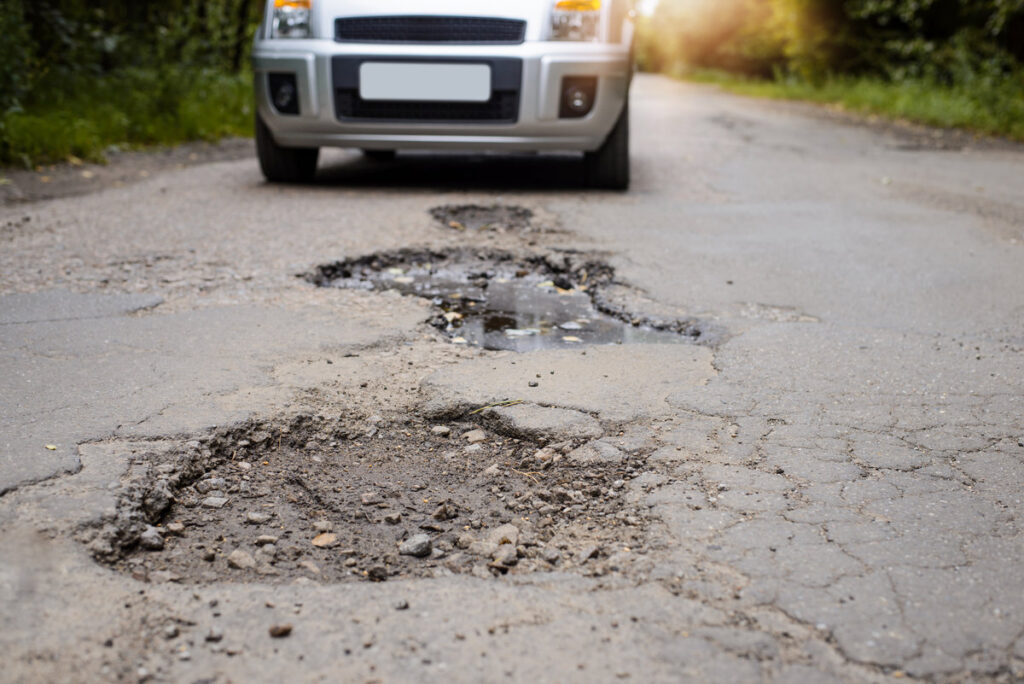
If you’ve been in a car accident caused by dangerous road conditions in California, you face a critical deadline that could forever determine your legal rights. You have only 6 months from your accident date to file a formal claim against the responsible government entity – not the typical 2-year deadline for private lawsuits. Missing this absolute deadline permanently bars you from recovering compensation for your injuries, vehicle damage, and other losses, no matter how severe the road defect or how strong your case.
Road defect car accidents in California occur when dangerous conditions like potholes, missing traffic signs, uneven pavement, or design flaws cause vehicle damage or personal injury. Under the California Tort Claims Act (Government Code §§810-996.6), government entities can be held liable for maintaining safe roadways, but the strict procedural requirements make these cases significantly more complex than typical auto accident claims.
This article provides general information only and is not legal advice. Given the strict 6-month deadline and complex procedures, you must consult with a qualified California government claims attorney immediately to protect your rights.
Why California’s 6-Month Government Claim Deadline Is Absolutely Critical
Unlike accidents involving private parties where you have two years to file a lawsuit, California Government Code §911.2 mandates that all claims against government entities must be filed within exactly 6 months of the incident. This deadline applies whether you’re suing Caltrans for a state highway defect, your city for a pothole, or your county for a dangerous intersection.
The 6-month rule is absolutely unforgiving. California courts consistently dismiss cases where claimants miss this deadline by even a single day. At our firm, we’ve seen devastating cases where seriously injured accident victims lost their right to any compensation simply because they didn’t understand the shortened government claim timeline.
What Happens When You Miss the 6-Month Deadline
Missing the 6-month deadline results in automatic case dismissal, regardless of the severity of your injuries or the obvious nature of the road defect. California courts have extremely limited authority to grant exceptions – typically only when the government entity actively concealed the defect or when late discovery of government involvement occurs through no fault of the victim.
Common scenarios where people miss the deadline include assuming the standard 2-year statute of limitations applies, filing with the wrong government entity, or discovering government responsibility months after the accident. Once the 6-month window closes, you permanently lose all rights to compensation.
How the 6-Month Clock Starts Ticking
The deadline begins on your accident date, not when you discover the government’s responsibility or when your injuries fully develop. Weekends and holidays don’t extend the deadline – if your 6-month anniversary falls on a Saturday, your claim must be filed by the preceding Friday.
For example, if your pothole accident occurred on March 15th, your government claim must be filed by September 15th of the same year. This calculation remains the same whether you immediately knew a government entity was responsible or discovered it weeks later.
Which Government Agency Is Responsible for Your Road Defect Accident
Identifying the correct government entity is crucial because filing with the wrong agency can cause fatal delays that prevent you from meeting the 6-month deadline. California’s road maintenance responsibilities are divided between different government levels, and each has specific claim filing procedures.
The California Department of Transportation (Caltrans) maintains state highways and interstate systems throughout California. Cities maintain streets within their boundaries, while counties handle roads in unincorporated areas and some rural highways. Filing your claim with the wrong entity means starting over with the correct one – time you may not have.
Caltrans Liability for State Highways and Interstates
Caltrans bears responsibility for maintaining all state highways (routes marked with state route numbers) and interstate highways within California. Common Caltrans liability scenarios include potholes on Highway 101, missing guardrails on Interstate 5, or inadequate signage in construction zones on state routes.
To identify Caltrans jurisdiction, look for state route markers or interstate signs. When in doubt, Caltrans maintains online jurisdiction maps, and their district offices can verify responsibility for specific road segments. Caltrans claims must be filed with their headquarters in Sacramento or the appropriate district office.
City and County Road Responsibility
Cities maintain all streets within their incorporated boundaries, from major boulevards to residential roads. Counties handle roads in unincorporated areas, rural highways not maintained by Caltrans, and some regional connectors between cities.
Local government road defects commonly include city street potholes, inadequate traffic signals at municipal intersections, or dangerous shoulder conditions on county roads. Each city and county has specific claim filing procedures, often requiring forms available only through their risk management or city attorney’s office.
Types of Dangerous Road Conditions That Create Government Liability
Not every road imperfection creates government liability – California law requires proving a “dangerous condition of public property” under Government Code §835. This means the road defect must create a substantial risk of injury when the property is used with due care in a manner reasonably foreseeable.
The key distinction is between normal wear-and-tear versus dangerous conditions. A small crack in asphalt typically doesn’t qualify, but a deep pothole that damages vehicles and causes drivers to swerve into traffic does. Courts evaluate the size, location, visibility, and hazard level of each defect.
Potholes and Pavement Defects
Potholes represent the most common type of road defect accident in California. However, not every pothole creates liability – courts generally require potholes to be substantial in size and depth, located where drivers cannot reasonably avoid them, and existing long enough that government inspections should have discovered them.
Dangerous pavement conditions also include edge drop-offs where pavement meets shoulders, uneven surfaces that cause vehicles to bottom out, and deteriorated asphalt that creates sudden elevation changes. Visual evidence showing the defect’s size relative to vehicles or common objects proves essential for these claims.
Missing or Defective Traffic Signs and Signals
Government entities must maintain adequate traffic control devices, including stop signs, traffic signals, lane markings, and warning signs. Liability can arise from completely missing signs, malfunctioned traffic lights stuck on certain phases, faded road markings that create confusion, or inadequate warning signs in construction zones.
At our firm, we recommend photographing the exact location where traffic control should exist, documenting sight line obstructions, and gathering witness statements about traffic patterns at the accident location. Time-stamped photos showing signal malfunctions or missing signs provide crucial evidence.
Dangerous Road Design and Construction Defects
Design defects occur when roads are built according to approved plans that create inherently dangerous conditions. These cases are more complex because California provides “design immunity” protection when government entities follow approved engineering plans – unless conditions change after construction or the design was clearly inadequate.
Construction zone accidents often involve contractor negligence, but government entities retain liability for inadequate oversight, insufficient warning signs, or dangerous temporary traffic control. Active construction zones require enhanced safety measures, and government failure to enforce contractor compliance can create liability.
Proving the Government Knew or Should Have Known About the Road Defect
California Government Code §835 requires proving the government had either actual notice of the dangerous condition or should have known about it through reasonable inspection and maintenance programs. This notice requirement often determines whether your case succeeds or fails.
Actual notice means the government entity specifically knew about the defect through complaints, work orders, or direct observation. Constructive notice means the defect existed long enough that reasonable inspection procedures should have discovered it. Courts apply community-specific standards based on traffic volume, inspection frequency, and available resources.
Actual Notice Evidence
The strongest cases involve documented government knowledge of the defect before your accident. This includes citizen complaints filed with city hall, work orders showing planned repairs, inspection reports noting the hazard, or correspondence between government departments about the condition.
Public records requests under the California Public Records Act can uncover internal government communications, maintenance logs, and prior accident reports at the same location. These documents often reveal that government entities knew about dangerous conditions but failed to take timely corrective action.
Constructive Notice Standards
When actual notice doesn’t exist, you must prove the government should have known about the defect through reasonable inspection. California courts don’t require perfect road conditions, but they do expect government entities to maintain regular inspection programs appropriate for each road’s traffic volume and importance.
High-traffic arterials require more frequent inspection than rural roads. Weather conditions also matter – winter storms that create potholes may require accelerated inspection schedules. The defect must typically exist for weeks or months to establish constructive notice, depending on the specific location and government entity’s inspection practices.
Critical Evidence You Must Collect Immediately After Your Accident
Time is your enemy in government road defect cases – evidence deteriorates rapidly, government entities often repair defects quickly after accidents, and witness memories fade. Immediate evidence collection can make the difference between a successful claim and a dismissed case.
Document everything while details remain fresh and the scene remains unchanged. Government maintenance crews may fill potholes or install warning signs within days of your accident, eliminating crucial evidence. Weather conditions can also alter road defects, making later documentation less reliable.
Photographing and Documenting the Road Defect
Take multiple photographs from various angles showing the defect’s size, location, and relationship to traffic patterns. Include reference objects like coins, shoes, or measuring tools to demonstrate scale. Photograph the defect from a driver’s perspective to show visibility and avoidability issues.
Environmental documentation matters equally – show lighting conditions, sight line obstructions, weather effects, and traffic volume. If the accident occurred at night, return during similar conditions to photograph visibility issues. Video documentation can effectively show the defect’s impact on vehicle handling and driver visibility.
Obtaining Government Records and Maintenance History
File immediate public records requests seeking maintenance logs, inspection reports, prior complaints, and accident histories for the specific location. Most government entities must respond within 10 days, though complex requests may take longer.
Request records from multiple time periods – recent maintenance might show awareness of problems, while longer histories can reveal patterns of complaints or recurring defects. Include requests for budget documents, staffing levels, and inspection protocols that might explain inadequate maintenance.
How to File Your Government Claim Within the 6-Month Deadline
Government Code §910 requires specific information in your written claim, and technical deficiencies can invalidate otherwise valid claims. The claim form varies by government entity, but all must include factual allegations, damage estimates, and proper legal service.
Filing requirements are strictly enforced – courts regularly dismiss claims for technical defects like insufficient factual detail, incorrect damage calculations, or improper service procedures. Unlike private accident claims where you can file lawsuits immediately, government claims require this preliminary administrative step before any court action.
Required Information for Your Government Claim
Your claim must include the specific date, time, and location of the accident, detailed description of the road defect and how it caused your accident, complete damage inventory including medical expenses and lost wages, and specific factual allegations supporting government liability.
Avoid conclusory statements like “the government was negligent” – instead, provide specific facts such as “a pothole approximately 18 inches wide and 6 inches deep located in the right traffic lane caused my vehicle to lose control.” Include witness information, police report numbers, and supporting documentation with your claim.
Proper Service and Filing Procedures
Each government entity has specific service requirements – some accept email filing, others require certified mail or personal service. Caltrans requires service on their Sacramento headquarters, while cities and counties typically accept service through their clerk’s office or risk management department.
Obtain delivery confirmation for all filings and maintain detailed records of service dates and methods. Many government entities provide claim receipt acknowledgments, which serve as crucial proof of timely filing. Missing these procedural requirements can invalidate otherwise meritorious claims.
Government Defenses That Can Defeat Your Road Defect Claim
Government entities have powerful immunity defenses unavailable to private defendants. Design immunity under Government Code §830.6 protects government entities when roads are constructed according to approved plans, even if those plans later prove inadequate.
Discretionary function immunity protects policy-level decisions about budget allocation, inspection frequency, and maintenance priorities. Courts distinguish between protected discretionary functions (deciding how often to inspect roads) and ministerial duties (actually conducting promised inspections).
Design Immunity and Approved Plans
Design immunity applies when government entities can prove the dangerous condition resulted from approved design plans prepared by licensed engineers. This defense commonly arises in intersection accidents, highway on-ramp cases, and situations involving inadequate sight distances.
However, design immunity has important exceptions – it doesn’t apply when conditions change after construction, when the design was clearly inadequate for intended use, or when maintenance failures create hazards beyond the original design. Proving these exceptions requires expert engineering testimony and detailed analysis of design standards.
Discretionary Function Immunity
This immunity protects government policy decisions made at executive or legislative levels, including budget priorities, staffing allocations, and maintenance scheduling. Courts recognize that government entities have limited resources and must make difficult choices about competing priorities.
The immunity doesn’t extend to operational decisions about implementing adopted policies. If a city decides to inspect major roads monthly, failing to conduct those inspections becomes a ministerial failure not protected by discretionary immunity.
Ready to Protect Your Rights Against Government Road Defect Negligence?
Road defect car accidents involving government liability require immediate action due to California’s strict 6-month claim filing deadline. These cases involve complex legal procedures, powerful government immunity defenses, and technical evidence requirements that make professional legal representation essential for protecting your rights and maximizing your recovery.
At our firm, we understand the urgent deadlines and intricate procedures governing California government claims. Our experienced attorneys help accident victims navigate the California Tort Claims Act, identify responsible government entities, gather crucial evidence, and file compliant claims that preserve your right to full compensation. We work diligently to hold government entities accountable for maintaining safe roadways while helping injured drivers recover medical expenses, lost wages, and pain and suffering damages. Contact us today at (555) 123-4567 or through our online consultation form to discuss your road defect accident case and ensure you meet all critical deadlines.